



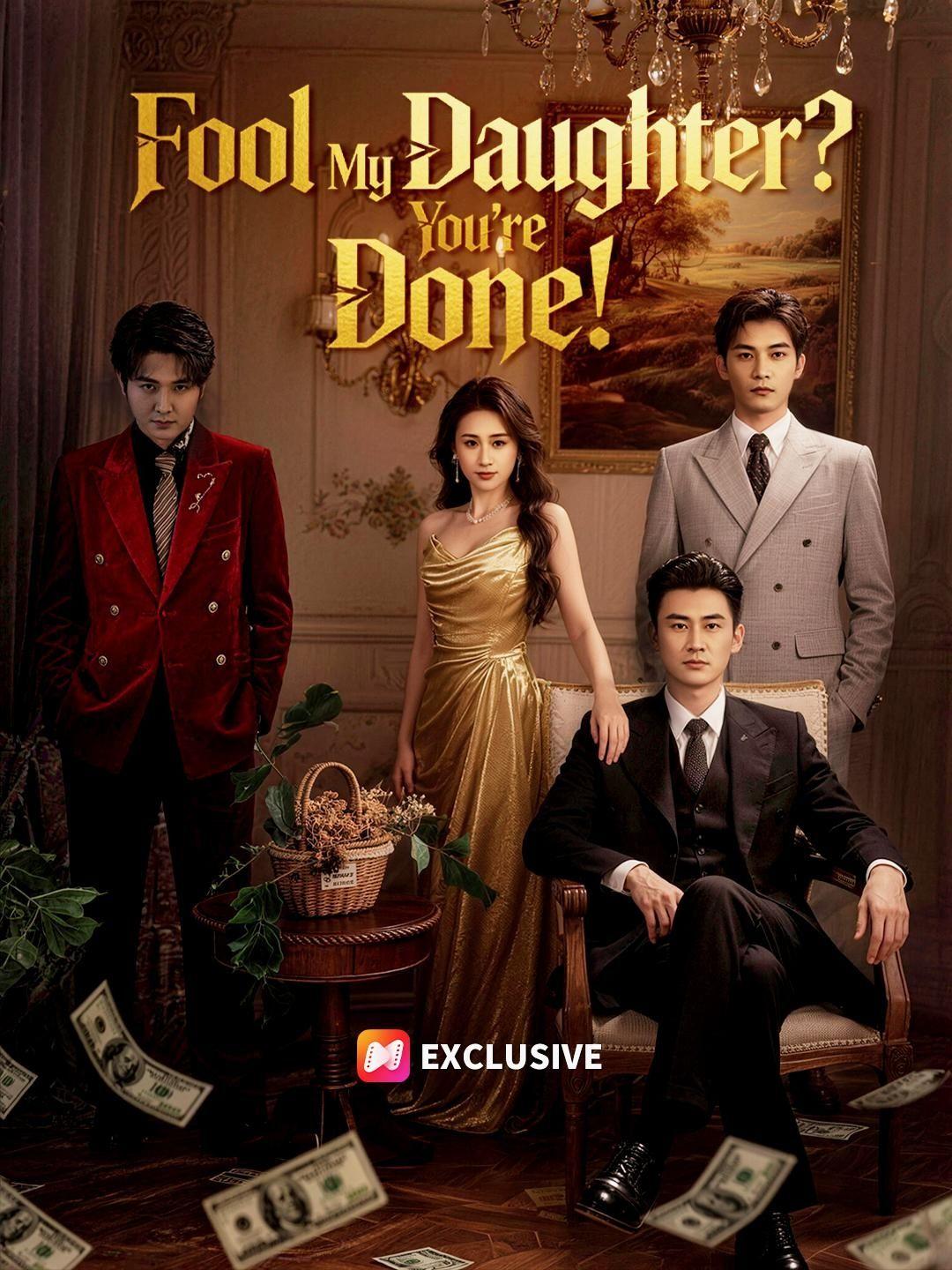
Defiance Against the Divine
The four great families unite to eliminate a perceived fool who defiles the divine palace, underestimating his true power and connection to the Palace of Nine Heavens.Will the mysterious stranger's claims about the Palace Master hold true, or will the four great families' actions lead to their downfall?


Recommended for you


Afterlife Love: When the Lotus Blooms in Bloodlight
The first thing you notice in *Afterlife Love* isn’t the costumes—it’s the *weight* in the air. Not humidity, not perfume, but consequence. The venue is pristine: white walls, geometric arches, a black-and-white checkered floor that mirrors the moral ambiguity unfolding above it. Every character moves like they’re walking on thin ice, aware that one misstep could shatter the entire facade of civility. Lin Zhen stands near the center—not commanding attention, but *holding* it, like a stone in a still pond. His red dragon robe isn’t celebratory; it’s ceremonial armor. The dragons coil around his torso not as decoration, but as guardians—or jailers. When he tilts his head upward, lips parted just enough to let out a breath he’s been holding since the ceremony began, you realize he’s not waiting for the vows. He’s waiting for the rupture. Shen Yao, meanwhile, is a paradox in motion. His attire—a fusion of Qing-era cut and steampunk hardware—suggests a man caught between eras, ideologies, loyalties. The leather straps across his chest aren’t fashion; they’re restraints. And that sapphire brooch? It pulses faintly in certain angles, as if responding to Mei Ling’s proximity. Their interaction is choreographed like a dance with invisible strings: she extends her hand, he takes it, but his thumb brushes the inside of her wrist—not tenderly, but *testingly*, as if checking for a pulse that shouldn’t be there. Because in *Afterlife Love*, the dead don’t stay buried. They linger in heirlooms, in family crests, in the way a bride’s veil catches the light just before she blinks away tears she hasn’t cried yet. Mei Ling’s transformation across the sequence is subtle but seismic. At first, she’s poised—too poised. Her smile doesn’t reach her eyes, which dart between Shen Yao, Lin Zhen, and the ornate golden lotus she cradles like a sacred text. Then, as Wei Jun enters—sharp-suited, bow-tied, his jeweled pin catching the light like a warning beacon—her composure cracks. Not dramatically, but in increments: a flinch when he speaks, a slight turn of her shoulder away from Shen Yao, a grip tightening on the lotus stem until her knuckles whiten. That vessel isn’t just symbolic; it’s functional. Later, when Shen Yao lifts it, blue energy spirals upward like smoke from a spirit lamp, confirming what the audience has suspected: this isn’t a wedding gift. It’s a conduit. A binding tool. A key. The supporting cast elevates the tension without uttering a word. The bald elder in silver brocade doesn’t just observe—he *calculates*. His raised finger isn’t scolding; it’s counting down. The bearded man with the dragon robe and prayer beads? He watches Shen Yao with the quiet intensity of a priest monitoring a sacrificial rite. And then—the crowd’s sudden recoil. No explosion, no scream, just a collective intake of breath and hands flying to heads, as if struck by an invisible wave. This isn’t panic. It’s *recognition*. They’ve felt this energy before. In dreams. In ancestral stories. In the hushed warnings passed down through generations: *When the lotus glows, the veil thins.* Which brings us to the climax—the ivory-clad stranger. His entrance is understated, yet the room *bends* around him. No fanfare, no music swell—just the soft whisper of silk against marble as he strides forward, flanked by two silent attendants who move like shadows given form. His outfit is minimalist, but the bamboo embroidery on his chest isn’t decorative; it’s a sigil. In Chinese cosmology, bamboo symbolizes resilience, yes—but also *return*. The dead who refuse to stay gone. When he locks eyes with Mei Ling, her breath hitches. Not because she’s afraid. Because she’s *relieved*. The tension in her shoulders dissolves, replaced by something quieter, heavier: surrender. Or acceptance. In *Afterlife Love*, love isn’t chosen—it’s remembered. And sometimes, the person you’re meant to stand beside isn’t the one at the altar. It’s the one who walks through the door long after the vows are spoken, carrying the scent of old paper and rain-soaked temples. The final frames cement the show’s thematic core: ritual as rebellion. Shen Yao doesn’t drop the lotus. He *activates* it. Blue light floods the hall, not violently, but deliberately—as if the building itself is exhaling a truth it’s held for centuries. Lin Zhen smiles then, not kindly, but knowingly. He nods once, slowly, as if approving a decision made long before this day. And Mei Ling? She doesn’t look at Shen Yao. She looks *through* him, toward the ivory figure now standing beside her, his hand hovering near hers—not touching, not yet. The space between them hums. *Afterlife Love* understands that the most devastating romances aren’t about separation, but about *delay*. About souls bound by lifetimes, forced to wait while the world rebuilds itself around them. This isn’t fantasy. It’s folklore with teeth. It’s history wearing silk. And when the credits roll, you don’t wonder what happens next—you wonder how many generations had to suffer before *this* moment was finally allowed to breathe. *Afterlife Love* doesn’t give answers. It gives echoes. And in those echoes, you hear your own heartbeat, syncing with the rhythm of a love that refuses to die—even when the body does.
Afterlife Love: The Dragon Robe and the Shattered Vow
In a grand hall where marble floors gleam under soft chandeliers and arched glass doors frame the entrance like a stage curtain, *Afterlife Love* unfolds not as a quiet romance but as a collision of tradition, power, and suppressed emotion. The opening frames fixate on Lin Zhen—his red dragon-embroidered jacket shimmering with metallic threads, each coil of the mythical beast seeming to writhe under the light. His goatee is neatly trimmed, his eyes sharp yet weary, as if he’s seen too many vows broken before they’re even spoken. He doesn’t speak much in these early moments, but his mouth tightens, his brow furrows just enough to betray internal turbulence. He’s not merely an elder; he’s a gatekeeper of legacy, and every glance he casts toward the young couple feels like a verdict being drafted in real time. Then there’s Shen Yao—the groom—dressed in a hybrid ensemble that screams modern rebellion wrapped in classical restraint: black silk with gold-dusted motifs, leather straps across the chest like armor, a sapphire brooch pinned over his heart like a wound he refuses to name. His posture is upright, almost defiant, but his fingers tremble slightly when he reaches for the bride’s hand. That moment—when their palms meet—is shot in slow motion, the camera lingering on the contrast: her white sleeve, delicate and translucent, against his dark cuff, heavy with symbolism. She grips his hand not with devotion, but desperation. Her expression flickers between fear and resolve, as though she’s rehearsing a script she didn’t write. And then, the golden lotus vessel—held by her trembling fingers—becomes more than a prop; it’s a relic, a covenant, perhaps even a curse. In *Afterlife Love*, objects carry weight far beyond their material form. The bride, Mei Ling, wears a gown that merges bridal purity with celestial opulence: crystal-encrusted collar, sheer shoulders revealing skin like porcelain under moonlight, and a tiara so intricate it looks less like jewelry and more like a crown forged from frozen tears. Her earrings dangle like pendulums, swaying with each breath, each hesitation. When she glances at Lin Zhen, her lips part—not to speak, but to suppress sound. That silence speaks volumes. Later, when Shen Yao turns to face the crowd, his jaw sets, his voice (though unheard in the silent clip) seems to vibrate with restrained urgency. He’s not asking permission—he’s declaring intent. And yet, the way he keeps his other hand clenched at his side suggests he knows the cost. Enter Wei Jun, the man in the tuxedo with the jeweled cross pin—a figure who arrives like a plot twist disguised as a guest. His expressions shift rapidly: surprise, disbelief, then something darker—recognition? Jealousy? His gestures are theatrical, almost mocking, as if he’s performing outrage for an audience that doesn’t yet realize the stakes. When he points, it’s not accusatory—it’s revelatory. He knows something the others don’t. Or perhaps he *thinks* he does. In *Afterlife Love*, truth is never singular; it fractures across perspectives like light through a prism. The background characters aren’t filler—they’re witnesses, complicit in the drama simply by standing still. A bald man in silver-gray brocade raises a finger mid-sentence, his eyes wide with scandalous delight. Another elder, bearded and bespectacled, wears a black robe embroidered with twin golden dragons, his prayer beads dangling like a countdown timer. Their presence anchors the scene in cultural gravity: this isn’t just a wedding—it’s a ritual, a reckoning, a transfer of spiritual authority. When the guests suddenly duck and cover in synchronized panic (64–65), it’s not fireworks they fear—it’s fate itself detonating in real time. And then—silence. The camera pulls back to reveal the arched doorway again, now empty except for two figures emerging: a new man, clad in ivory silk with ink-black bamboo motifs, walking with the calm of someone who’s already won. His entrance isn’t loud, but it halts the chaos. The crowd parts not out of respect, but instinct. This is where *Afterlife Love* reveals its deepest layer: love here isn’t about choice—it’s about inheritance, debt, and the ghosts we carry into our vows. Shen Yao’s earlier tension wasn’t just about Mei Ling; it was about the man now stepping forward, the one whose arrival rewrites the ceremony’s ending before the first blessing is spoken. What makes *Afterlife Love* so gripping is how it weaponizes stillness. No shouting matches, no slap scenes—just micro-expressions, a tightened grip, a swallowed gasp. When Mei Ling finally turns her head toward the newcomer, her pupils contract. Not fear. Recognition. And in that instant, the entire narrative pivots. The golden lotus she holds? It’s not for the groom. It’s for *him*. The one who walks like wind through ancient corridors, who carries silence like a sword. *Afterlife Love* doesn’t ask who she loves—it asks who she *owes*. And in a world where ancestral contracts bind the living to the dead, love is never free. It’s inherited. It’s negotiated. It’s paid for—in blood, in time, in stolen glances across a banquet hall where everyone knows the truth but no one dares speak it aloud. The final shot—Shen Yao holding the lotus now, blue energy crackling around it like trapped lightning—confirms what we suspected all along: this isn’t a wedding. It’s an exorcism. And *Afterlife Love* is just getting started.
When the Lotus Glows Blue
The moment the golden lotus flares with blue energy? Chills. The groom’s calm vs. the tuxedo man’s panic creates perfect tension. Afterlife Love blends tradition and fantasy like tea and thunder—elegant, then explosive. That handhold? Pure emotional detonation. 💫
The Red Dragon’s Silent Judgment
That elder in crimson brocade—his eyes say everything. No words needed when he watches the groom’s hesitation, the bride’s trembling grip. In Afterlife Love, power isn’t shouted; it’s stitched into silk and silence. 🐉✨ Every glance is a verdict.