



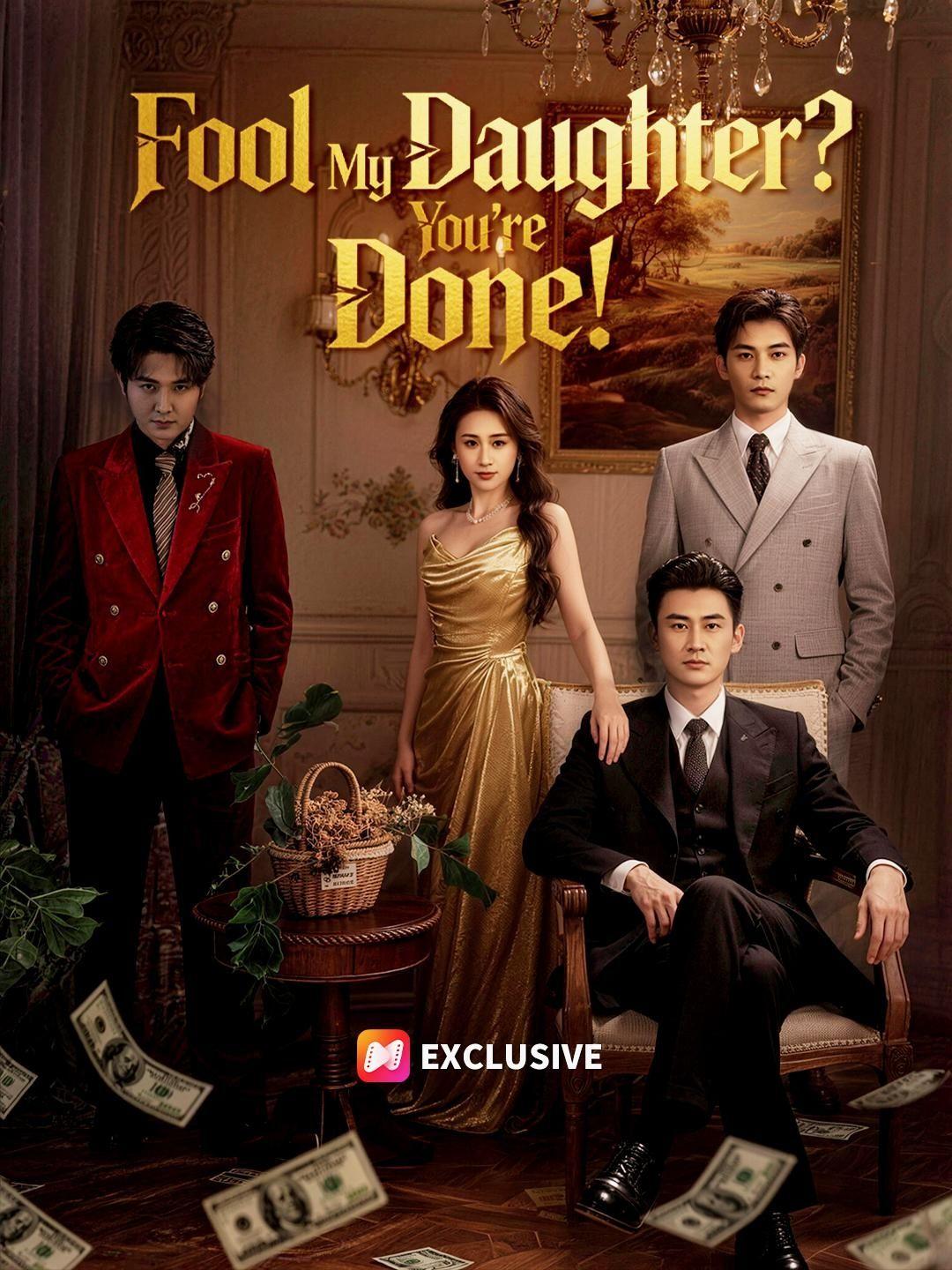
Clash of the Past
Amara Lyle and Zoe Stilwell, once from the same humble beginnings, meet again at a high-profile banquet hosted by Jeremy Howard. Their reunion quickly turns into a heated confrontation, revealing deep-seated resentment and rivalry. Amara, now married to a CEO, belittles Zoe, questioning her right to be at the event. Zoe, however, holds her ground, hinting at a deeper connection to the evening's host.What secret link does Zoe have to Jeremy Howard that could turn the tables on Amara?


Recommended for you


Lost and Found: When a Hallway Becomes a Courtroom
The most devastating confrontations rarely happen in courtrooms or interrogation rooms. They happen in lobbies. In hallways. In spaces designed for transition, where people expect to move through, not to break apart. That’s the chilling brilliance of Lost and Found: it transforms a luxurious hotel corridor—its polished floors reflecting distorted images of the people standing upon them—into a stage for psychological warfare, where the weapons are not knives or guns, but a folded card, a well-placed glance, and the unbearable weight of unspoken history. This isn’t melodrama; it’s realism sharpened to a razor’s edge, and every frame pulses with the kind of tension that makes your own throat constrict. Li Meihua is the engine of this scene. She doesn’t walk into the confrontation; she *enters* it, shoulders squared, chin lifted, her black-and-white striped top a visual metaphor for her worldview: clear-cut, binary, uncompromising. The stripes don’t flow; they cut across her torso, rigid and declarative. Her pearl necklace, adorned with a recognizable interlocking logo, isn’t just jewelry—it’s armor, a badge of belonging, a reminder of where she believes she stands in the hierarchy of this world. Her hands are never still. One grips a structured handbag, the other gestures with precision, as if conducting an orchestra of accusations. When she raises the invitation card—its glossy surface catching the ambient light—she doesn’t show it; she *brandishes* it. The characters on it, though indistinct in the frames, feel like verdicts. Her mouth forms words that we can almost hear: sharp consonants, rising inflections, sentences that end not with periods, but with question marks turned into exclamation points. She’s not seeking answers; she’s demanding confessions. Her eyes, wide and unblinking, lock onto Yuan Lihua not with hatred, but with a kind of furious disappointment—as if the person she’s confronting has failed a test she didn’t know she was taking. Yuan Lihua, meanwhile, is the counterpoint: stillness as resistance. Her mauve silk blouse, with its traditional knot fastenings and soft ruffles, speaks of quiet elegance, of restraint, of a life lived with careful intention. But her body tells a different story. Her posture is erect, yes, but her neck is tense, tendons visible like cords under skin stretched too thin. Her lips press together, then part slightly—not to speak, but to release a breath she’s been holding since the first word was uttered. Her gaze flickers, not with guilt, but with a profound disorientation, as if the ground beneath her has shifted without warning. She doesn’t raise her voice. She doesn’t gesture. Her power lies in her refusal to play Li Meihua’s game. When Li Meihua escalates, Yuan Lihua doesn’t retreat; she *contracts*, folding inward, making herself smaller, quieter, more difficult to attack. It’s a defense mechanism honed over years of navigating emotional minefields. And yet, in that contraction, there’s vulnerability—a crack in the porcelain that lets the light in, and the pain out. Her earrings, simple studs, catch the light like dewdrops on a leaf about to fall. She is, in this moment, utterly exposed. Mr. Chen—the man in the dark suit—exists in the negative space between them. He is the silent witness, the arbiter who refuses to arbitrate. His hands in his pockets suggest ease, but his stance is rooted, immovable. He watches Li Meihua’s performance with the mild interest of someone observing a familiar play, perhaps even one he helped write. His smile, when it appears, is fleeting, a ghost of amusement that vanishes before it fully forms. It’s not cruel, exactly; it’s *indifferent*. He understands the rules of this game better than anyone. He knows that Li Meihua needs to be seen as righteous, and Yuan Lihua needs to be seen as broken—and he is content to let the narrative unfold without interference. His presence is the linchpin. Without him, this might be a private argument. With him, it becomes a sanctioned reckoning. He is the reason the invitation card matters. He is the reason the hallway feels like a stage. In Lost and Found, he represents the institutional silence that allows personal dramas to fester until they explode in public spaces. Then comes the guard. His entrance is understated, almost bureaucratic, yet it lands like a hammer blow. Black uniform, cap with insignia, posture rigid, eyes scanning the periphery. He doesn’t engage. He doesn’t speak. He simply *is*, and his being changes everything. The moment he steps into the frame, the emotional temperature drops. Li Meihua’s fervor wavers; her gestures become slightly smaller, more contained. Yuan Lihua’s breathing hitches, a tiny, almost imperceptible intake of air. The guard isn’t there to take sides; he’s there to ensure the venue remains orderly. And in doing so, he renders the entire emotional exchange suddenly, brutally *small*. What felt like a cosmic injustice a second ago now risks becoming a nuisance complaint. The invitation card, once a symbol of irrefutable proof, now looks like a piece of paper that could be confiscated, filed, forgotten. The guard’s neutrality is the ultimate indictment: this isn’t a tragedy; it’s a disturbance. What elevates Lost and Found beyond mere soap opera is its commitment to ambiguity. We never learn what the invitation was for. We don’t know who was invited, who was excluded, or why Yuan Lihua’s presence—or absence—is the catalyst. The conflict isn’t resolved; it’s *frozen*. The final shots linger on Yuan Lihua’s face, her expression unreadable: is it sorrow? Resignation? A dawning realization that the truth she’s been protecting is no longer hers to hold? Li Meihua, for her part, looks momentarily unsure, as if the roar of her own voice has finally reached her ears, and she’s startled by its volume. The hallway, once a neutral space, now feels charged, haunted. Every reflection in the marble floor seems to hold a fragment of the argument, a splintered version of the truth. This is where the title Lost and Found finds its deepest resonance. It’s not about a misplaced item. It’s about identity. Yuan Lihua has lost the narrative she’s been living—the story she told herself about who she is, who she belongs with, what she deserves. And Li Meihua, in her fury, is desperately trying to find the version of the past that validates her current rage. But the past, as Lost and Found so masterfully shows, isn’t a thing you can retrieve like a wallet from a lost-and-found desk. It’s a story, and stories change depending on who’s holding the pen. The hallway, with its echoing silence and indifferent architecture, becomes the perfect metaphor: a place where people pass through, but sometimes, just sometimes, they get stuck—trapped between who they were, who they are, and who everyone else insists they must be. The real tragedy isn’t the argument. It’s the realization, dawning in Yuan Lihua’s eyes as the guard approaches, that some doors, once opened, can never be closed again. And the invitation? It wasn’t an entry ticket. It was a detonator.
Lost and Found: The Invitation That Shattered Composure
In the opulent, softly lit corridor of what appears to be a high-end hotel or private club—marble floors gleaming under ornate chandeliers, arched doorways framing blurred greenery beyond—the tension doesn’t erupt; it simmers, then boils over in micro-expressions. This isn’t a scene from a thriller with gunshots or chase sequences. It’s far more unsettling: a social confrontation where every blink, every purse grip, every slight tilt of the chin carries the weight of years of unspoken history. Lost and Found, as the title suggests, is less about physical objects and more about the reemergence of buried truths—and how fragile human dignity becomes when those truths are held up to the light. At the center of this emotional vortex stands Li Meihua, the woman in the black-and-white striped top, her pearl necklace—a Chanel pendant glinting like a tiny accusation—hanging heavy around her neck. She doesn’t just speak; she *performs* indignation. Her mouth opens wide not in shock, but in practiced outrage, her eyes darting between the two people flanking her: a man in a dark suit, his hands casually tucked into his pockets, radiating smug neutrality, and another woman—Yuan Lihua—in a muted mauve silk blouse with delicate Chinese knot buttons, whose face remains a study in restrained devastation. Li Meihua’s gestures are theatrical: she lifts a small black invitation card at one point, its white characters stark against the dark surface, and waves it like a judge’s gavel. The card reads ‘Invitation’—but in this context, it’s less an invitation and more a subpoena. She doesn’t just present it; she *accuses* with it. Her fingers tighten on the handle of her brown Dior-patterned handbag, knuckles whitening, as if bracing for impact. Her voice, though unheard in the silent frames, is palpable: sharp, rhythmic, punctuated by pauses that let the silence scream louder than words ever could. Yuan Lihua, by contrast, is a portrait of internal collapse. Her posture is upright, almost defiantly so, yet her shoulders subtly slump after each of Li Meihua’s verbal volleys. Her lips part—not to retort, but to inhale, as if trying to steady herself against a physical blow. Her eyes, large and dark, flicker between Li Meihua, the man beside her (who remains mostly off-frame, only glimpsed in silhouette), and the floor. There’s no anger in her gaze, only sorrow, confusion, and a dawning horror. She blinks slowly, deliberately, as if trying to process something that defies logic. When she finally speaks—her mouth forming soft, rounded shapes—it’s not with fire, but with a quiet desperation, a plea disguised as explanation. Her earrings, simple pearls matching Li Meihua’s but smaller, catch the light like tears she refuses to shed. This is where Lost and Found reveals its true texture: it’s not about who is right or wrong, but about how memory fractures under pressure. Yuan Lihua isn’t defending herself; she’s reconstructing a narrative that has just been violently dismantled. The man in the suit—let’s call him Mr. Chen, based on contextual cues—functions as the silent fulcrum of the scene. He watches, occasionally smiling faintly, a gesture that reads less as amusement and more as detached satisfaction. His tie, patterned with subtle gold dots, matches the opulence of the setting but contrasts sharply with the raw emotion unfolding before him. He never intervenes. He doesn’t need to. His presence alone legitimizes Li Meihua’s performance. When he shifts his weight, hands still in pockets, it’s a minor movement that signals control. He’s not a participant; he’s the audience, and the architect. His calm is the most unnerving element of all. In Lost and Found, power isn’t shouted; it’s held in the stillness of a man who knows the script has already been written, and he holds the final page. Then there’s the security guard—black uniform, cap bearing a discreet emblem, arms crossed, stance rigid. He enters late, almost as an afterthought, yet his arrival changes the atmosphere entirely. He doesn’t look at the women; he looks *past* them, scanning the corridor, assessing exits, threats. His expression is neutral, professional, but his timing is deliberate. He appears precisely when Li Meihua’s voice reaches its crescendo, when Yuan Lihua’s composure threatens to shatter completely. His presence isn’t protective; it’s procedural. It signals that this isn’t a private dispute anymore—it’s now a matter of venue protocol. The moment he steps into frame, the emotional stakes shift from personal betrayal to public consequence. Li Meihua’s outrage suddenly feels performative, even desperate, as if she’s aware the curtain is about to fall. Yuan Lihua’s despair deepens; she glances toward the guard, not with hope, but with resignation. The invitation card, once wielded like a weapon, now seems absurdly small in her rival’s hand. What makes Lost and Found so compelling is how it weaponizes domesticity. This isn’t a boardroom showdown or a courtroom drama. It’s a hallway. A place of transit. And yet, within those few square meters, lifetimes collide. The striped top versus the silk blouse isn’t just fashion—it’s class, upbringing, moral authority. The pearls versus the stud earrings aren’t accessories; they’re symbols of inherited privilege versus earned grace. Li Meihua’s animated gestures suggest a woman accustomed to being heard, to commanding attention, while Yuan Lihua’s minimal movement speaks of someone who’s spent years listening, absorbing, waiting. Their conflict isn’t about the event on the invitation—it’s about who gets to define the past. Who gets to remember? Who gets to forget? The lighting plays a crucial role. Warm, golden tones dominate, evoking luxury and comfort, yet the shadows are deep, pooling around the characters’ feet, hinting at the darkness beneath the surface. The chandelier above casts halos of light, but also creates harsh highlights on foreheads and cheekbones, emphasizing every twitch of muscle, every suppressed tremor. When the camera cuts quickly between faces—Li Meihua’s widening eyes, Yuan Lihua’s trembling lower lip, Mr. Chen’s barely-there smirk—it mimics the frantic rhythm of a heartbeat under stress. There’s no music, no score, yet the silence is deafening, filled only by the imagined echo of Li Meihua’s voice and the soft rustle of silk as Yuan Lihua shifts her weight. Lost and Found excels in its refusal to resolve. The video ends not with a climax, but with a pause—a breath held too long. Yuan Lihua looks away, her gaze fixed on some distant point, as if retreating inward. Li Meihua lowers the invitation card, her expression shifting from triumph to something else: uncertainty? Fatigue? The guard remains, a silent sentinel. Mr. Chen hasn’t moved. The scene doesn’t conclude; it *suspends*. And that’s the genius of it. We’re left not with answers, but with questions: What was on that invitation? Whose name was omitted? Why does Yuan Lihua look less guilty and more… betrayed? The title Lost and Found gains new meaning here: what was lost wasn’t just an object or an opportunity—it was trust, certainty, the illusion of stability. And what’s being found, painfully, is the truth that some invitations, once extended, can never be truly revoked—they linger, like ghosts in a marble hallway, whispering long after the guests have left.